Originally experienced – April 2019
Published on – 1st March 2025
It was raining the first time I met her. She had joined my team at work, and I don’t think I was the most welcoming. She knows for a fact that I wasn’t.
She was effervescent and a chatterbox; at the time, I was neither of those things. In fact, I’ve never really been either of those things.
In her first week I came back to my desk to find her looking apologetic. She had rolled over my wired earphones with a chair, breaking the earbuds. I joked that I would be sending her an invoice; she still tells people I was being sincere.
As time went on, we became friends. She and a few other colleagues were in relationships at the time and would live vicariously through my tales of single life. My horror stories would make them go home and hold their partners a little tighter each night.
After I became ill, the stories dried up, and any thoughts of future relationships were put on ice. But boredom won over, and I decided to download a dating app for the first time.
As I spent a lot of time resting, I treated the apps more like a game than a search for a partner. My self-esteem was probably at a low point and just seeing someone swipe right was a much-needed hit of dopamine.
But then I found that hitting a match wasn’t the end of the game; you had to talk too. The daily conversations became tiresome, and my inability to commit to any plans meant it was a waste of everyone’s time.
Then I had a match; we even shared a mutual friend who said we’d be perfect for each other. I hadn’t done anything socially for a few months, so I thought I would give it a go.
We planned to meet at my favourite Mexican place, but due to a doctor’s appointment going over, I was 90 minutes late.
When I arrived, I instantly noticed her. She was even more attractive than her photos. I sat down with butterflies in my stomach for the first time in a while. And then she spoke.
It’s not that she said anything wrong or had an accent I didn’t like (Potteries, for the record), but she was absolutely battered. A few after-work drinks had become extended because of my delay, and the Dutch courage was at its maximum.
Now, this was completely my fault, and I couldn’t care less that she was drunk, but she was a mean drunk.
Two minutes into the date, she said, “You’ve clearly never been on many of these before, have you?” and proceeded to ‘neg’ me like she had just discovered Neil Strauss’s The Game.
I kept looking up for a twinkle in the eye, some hint that she just had a dry sense of humour. It never came.
I eased up, the butterflies now dormant. Nothing was going to happen, so I could enjoy my margaritas and make the best of the situation.
It had been a while since I’d been out, so I was nervous and came equipped like a dating Michael Parkinson.
What a catch, eh?
However, each question was met with a look that suggested she would rather be anywhere else.
At one point, I even said that I wouldn’t mind if she wanted to leave. She exhaled heavily, paused, and then said she was fine.
I decided to tell her about my illness, thinking, things couldn’t get any worse. I saw it as good practice for telling someone new in the future.
Disinterested, she replied, “So what, you’re a tired boy?” A response that still makes me laugh.
Eventually, after torturing myself further, we left the restaurant and went our separate ways.
I came away from the whole thing disheartened, not because I thought ‘mean drunk girl’ was the one, but I knew this was how it would go. And the amount of energy I exerted just for that one date put me off trying again.
So, I deleted the apps and instead looked to focus my energy on my current friendships. And that’s exactly where the best thing in my life came from.
Talking at work evolved into the occasional text, which then became daily conversations that would last into the night. This blossoming friendship made my days feel longer, in a good way.
It progressed into seeing each other outside of work in group settings, which slowly dwindled into just us—and someone I started to fall for romantically.
When I asked her out for the first time, there was already something bubbling, but I wanted her to be aware of my illness. To know I was, “a tired boy.”
Her reaction was one of understanding. She was curious and asked the right questions, but ultimately, she was unphased. But in that moment, she couldn’t have known how much the illness would impact her future life too.
And I’m constantly aware of how lucky I am, especially when I speak to other chronic illness sufferers online and read questions like, “How could you ever start a relationship with this illness?”
I sometimes think about writing back, an empty platitude like, “You’ll find love when you stop looking,” but that’s not true. For a lot of people living with chronic illnesses, the romantic cliches feel like fantasy.
And if she wasn’t already in my life, then who knows where or who I’d be today.
She and I differed in many ways. When I look at the world, I see a darkened tint; she sees it in Technicolor. Where I can be heavy and burdened, if you tied her down, she would still drift off.
As the relationship progressed, my understanding of love grew with it.
Weirdly enough, before this relationship my understanding of love came from the computer game, The Sims. Like all computer games, everything is binary: you either did or didn’t land the kickflip, you either did or didn’t defeat Donkey Kong. And in The Sims, your characters are either in love or they’re not.
Within the game, every meeting and exchange would have a positive or negative impact on the relationship between two characters. Once it reaches a certain level (75%), then love is activated, and it can further increase until it hits 100%.
Now, to a certain extent, this is true, but what I learned is that when it hits 100%, that’s not the end. Because it doesn’t stop growing.
Love defies math and empiricism this way, it’s incremental. Because love grows, and it never stops.
Each time I watch her face subconsciously reenact the emojis she’s sending her friends.
Each time she shows me patience and understanding.
Each time she speaks gibberish in her sleep.
Each time she outsmarts me.
Each time she doesn’t make a fuss about how many things she has to do alone.
And it would grow and grow.
One of her favourite things is Christmas, and she routinely makes me feel like the Grinch for making her turn off Christmas songs. In my defence, it’s usually in July.
If you asked her what her favourite song is, she may say something by Fleetwood Mac, Maggie Rogers, Carole King, or something like that, but she’d be lying. The answer would be “Step into Christmas” by Elton John.
And I don’t think she could name her top 5 movies without selecting at least one Christmas film.
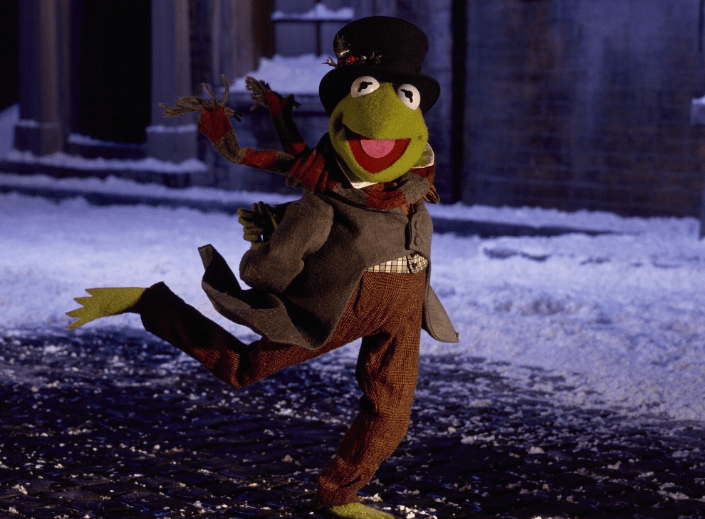
So, one December night, I was amazed when she told me that she’d never seen A Muppets Christmas Carol.
I put it on and was surprised that we had gone 10 minutes without any questions or comments. She’d often ask me, “What’s he doing?” or “Where do I know him from?” but this time she was silent.
Then a question finally came.
“Who is he?”
I paused it. Ebenezer Scrooge was on the screen.
Me: “That’s Michael Caine, you know, from…”
Her: “Blow the bloody doors off. I know Michael Caine; I meant next to him.”
I rewound it to make sure. She shouted, “Stop.”
I looked at her, then back at the screen to make sure my eyes weren’t deceiving me.
She was referring to Kermit the Frog.
It turned out that somehow, in her 30 years on this earth, she had never seen The Muppets. She was watching the first ten minutes completely confused by who everyone was and what they were doing in the time of Charles Dickens.
I now had to explain the concept of The Muppets, which is harder to do than you’d think.
“Erm, they’re kind of puppet animals, but some are people and have jobs like the Swedish Chef and the Scientists.”
She asked insane existential questions like, “Are they a figment of Michael Caine’s imagination?” and “Can the Muppets die?”
We were getting too far into the weeds when it came to Muppets lore, so I decided to press play and just crack on.
The film came to a musical sequence, ‘When Love is Gone’, a classic scene to go up against anything Caine did in The Italian Job. I tried to explain how this scene was on my VHS as a kid but was then deleted from subsequent versions for decades.
She stared at me like I had lost the plot.
The film came to an end, and I looked over at her, as silent as she’d ever been.
Me: “So, what did you think?”
Her: “….. I just couldn’t warm to the little green guy. Not for me.”
As I said, love is incremental.
 LIFE IN A CRASH